
HEARING ASSOCIATES
Audio-Mind-Processing Therapy

Dr. O’Boyle has created a proven method that allows patients to comfortably rewire their brain for Better Hearing.
Did you know that only about one-third of people with hearing loss wear hearing aids? Additionally, reports show that the hearing aid success rate in the U.S. is around 60%. That means 40% of people who invest in hearing aids are not satisfied. Many report hearing too much noise, difficulty understanding speech, and a lack of immediate benefit. Feeling overstimulated often leads to inconsistent hearing aid use, resulting in more frustration and communication problems. Dr. Angelica O’Boyle was once one of those patients, and she worked to develop a program that can realistically change the lives of people with hearing loss.
Some of the most common complaints about hearing aids involve the challenge of understanding a speaker while trying to ignore all the competing sounds around us. How does a hearing aid know who or what you are trying to hear? It can’t read your mind—so we need to give your brain the best possible training to increase your ability to understand the sounds you hear. With our Audio-Mind-Processing (AMP) Therapy program, we strive to change the lives of individuals with hearing loss in a positive and lasting way. This process can be improved.
Growing research shows how important hearing is for overall brain health, including memory and cognitive function. The sooner we can improve hearing and communication, the better. We also know that hearing loss often drives a wedge between people and their loved ones. Everyone deserves a treatment program that helps them become a successful hearing aid user, maintain healthy brain stimulation, and enjoy meaningful communication.
Dr. O’Boyle was an unsuccessful hearing aid user for years, wishing to hear better. She also found that many of her own patients expressed similar struggles, even when using “gold standard” approaches to hearing-loss treatment. This motivated her to create a solution, forming the foundation of her method for helping patients adapt to hearing aids. Our audiologists and team follow this proven process every day in our clinic, resulting in nearly 100% patient satisfaction.
Key Factors of AMP Therapy Success

Dr. O’Boyle’s AMP Therapy program has helped countless patients rediscover meaningful connections with the people around them. Through her clinical expertise, personal journey, and decades of experience, she identified the essential elements of a treatment roadmap that leads patients to truly successful hearing.
~In Depth Analysis to Select Technology Focused on Your Needs
With so many hearing technology options out there, choosing the right device can feel overwhelming. We make that process simple by starting with a complete evaluation and a detailed analysis of your needs. This ensures we select the device that truly fits your life—not just your hearing test results.
Too often, treatment plans focus only on the hearing aid. Our AMP Therapy approach goes far beyond that. We consider the whole person, integrating communication strategies, counseling, and supportive accessories. Because hearing loss can contribute to feelings of isolation or depression, we also include your loved ones to build stronger, more connected communication at home and beyond.
While some people choose devices based solely on price, insurance coverage, or appealing advertisements, technology alone cannot guarantee success. What matters just as much is the expertise behind it. True benefit comes from pairing the right device with a skilled clinician who knows how to fine-tune it, teach you how to use it, and guide you through your journey to better hearing.
~Devices That Are Properly Prescribed and Fit
Every ear has its own unique “fingerprint,” yet many specialists adjust hearing devices using only estimated prescriptions. This is also one of the biggest drawbacks of over-the-counter devices: even if they seem to help, there is no way to know how sound is truly being delivered to your ear without real-ear verification.
Some providers adjust devices based solely on what a patient says they are hearing, ignoring crucial objective data. Others do the opposite—focusing only on the verification readings and refusing to make changes when a patient still isn’t satisfied.
We’ve learned that neither of these approaches creates a positive patient experience. Successful hearing care requires both science and artistry. Dr. O’Boyle’s AMP Therapy program integrates both, and she has trained her team to provide comprehensive support and guidance at every step of your journey.
~Therapeutic Plan to Ease Your Brain Through the Rewiring Process
Most reputable audiologists will recommend technology that suits your hearing needs. Some will even use verification tools to make sure the devices match your prescription.
But the next step—helping your brain adjust to amplified sound—is one of the most important parts of your journey. It’s also where many treatment plans fall short. Our AMP Therapy approach stands out because we create a personalized therapeutic plan that gently guides your brain through the rewiring process. This support is especially crucial during the early stages when everything sounds new and overwhelming.
Many patients have shared that they were told they would simply “get used to” the sound, even when they felt improperly fit. Sometimes no adjustments were offered, or adjustments made little difference. This is often the point where patients lose motivation.
The world can feel very loud when you’re not used to hearing everything clearly, and it’s tempting to take the devices out. That leads to wearing them only occasionally. Then, every time you put them back in, your brain is overwhelmed again by noise and you still struggle to understand speech. This becomes discouraging for both you and the people you communicate with.
~Practice Makes Perfect
The world is a noisy place, and it’s natural to want to remove your hearing aids when everything feels overwhelming. This often leads to a habit of wearing them only when you think you “need” them. But inconsistent use creates a cycle: when you do put them back on, you are once again bombarded by environmental sounds while still struggling to understand speech. This can further discourage device use—and communication partners may also become discouraged.
Dr. O’Boyle often compares the hearing aid process to recovering from an injured leg. Think back to when you first noticed difficulty hearing, understanding speech, or when someone close to you commented that you seemed not to be listening. That moment may mark the beginning of your hearing changes. From then on, your auditory system may have slowly deteriorated, sending a weakened signal to the brain.
Now imagine that, on that same day, a cast was placed on your leg. The day you begin wearing hearing aids would be the equivalent of removing that cast for the first time. Many patients expect to hear perfectly in noise on day one—but that expectation is like trying to run a marathon the moment your cast is removed. If your leg had been immobilized for years, running smoothly might never be possible without gradual strengthening and practice.
This puts us in a difficult spot: we want to hear better, but we don’t want to be overwhelmed. Yet we cannot adapt to new sounds unless we practice wearing hearing aids consistently. Using the leg analogy again, wanting to perform well in noisy environments while only wearing your devices occasionally is like wanting to run a marathon after only taking a few short walks each week. The brain needs repetition and time to rewire itself—to relearn what sounds mean, to prioritize speech over background noise, and to navigate complex listening situations.
Our AMP Therapy method uses a unique blend of diagnostic measures, your personal experiences, data from your hearing technology, and gold-standard validation results. We integrate all of this information to refine your step-by-step adaptation plan, helping you adjust comfortably to the sounds of the world. Over the course of several weeks, our team customizes and manages your device settings to support your brain during this critical stage.
Once we establish your treatment path, we continue to guide and support you, adjusting your plan as your listening skills grow. Our AMP Therapy program has a proven record of transforming patients into successful, confident hearing aid users.
A.M.P. Therapy’s Roadmap to Better Hearing
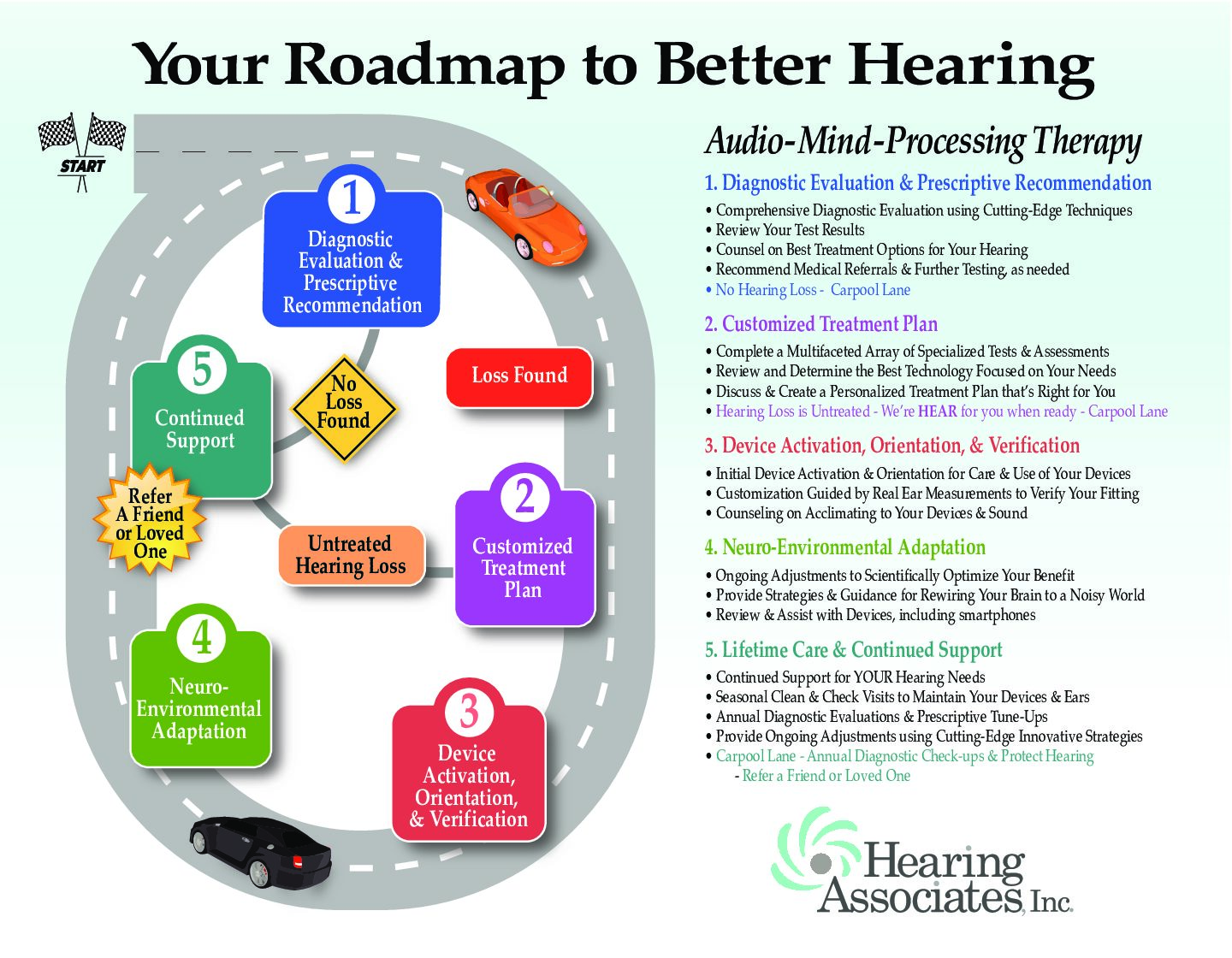
Schedule a Hearing
Assessment & Hearing Aid Evaluation

Hearing care begins with a hearing assessment. To properly treat hearing loss, we have to know what we’re up against. If you suspect that you or a loved one might be experiencing a hearing loss, there is no better time than today to take the first step toward better hearing, greater independence, and a more rewarding lifestyle. Please contact us to schedule a hearing assessment and get started on your journey to better hearing. Once you have a hearing assessment, you will be ready for your Hearing Aid Evaluation.